
New Castle County Superior Court Overview
Delaware has a unified statewide court system, and the Superior Court is the primary general-jurisdiction trial court. In New Castle County, Superior Court hears felony criminal prosecutions, large civil claims, civil jury trials, complex civil litigation, and many appeals from state boards and lower tribunals. The court is one of five trial-level state courts that share work across the county. It sits below the Supreme Court of Delaware on appeal. Other trial-level courts in the county include the Court of Chancery, Family Court, Court of Common Pleas, and Justice of the Peace Court.
Because Delaware courts are state-administered, Superior Court does not work like a county district court in Texas or Colorado. There is no county-elected district clerk over the court. Civil docketing and judgment records are kept by the Superior Court Prothonotary. Criminal prosecution comes from the Delaware Department of Justice, not a county district attorney. The court's New Castle County operations run out of the Leonard L. Williams Justice Center in downtown Wilmington. Cases here can range from local landlord disputes pushed up on appeal to nationally watched corporate and tort cases. The court's docket reflects the county's role as Delaware's legal and business hub.
Superior Court civil case numbers follow a county-coded format. A sample observed Superior Court civil case ID is N21C-08-063, where N marks New Castle County, 21 marks the year, and the rest of the code shows case type and filing sequence. Knowing the case ID format makes online lookup faster and more accurate.
New Castle County Superior Court Location
Superior Court business for New Castle County is handled at the Leonard L. Williams Justice Center in downtown Wilmington. The same building also houses Court of Chancery, Family Court, and Court of Common Pleas operations for the county. The court does not use a numbered division system like Texas district courts. Cases are assigned to judges by court administration rather than by court number, so a civil case here is just "Superior Court, New Castle County" rather than "Court #21" or similar.
The court of Chancery shares the same address and is Delaware's nationally important equity court. Many corporate, trust, and guardianship matters proceed in Chancery rather than in Superior Court, so a person searching for a Delaware court case should confirm which court has the file. A look at the official Court of Chancery site shows the building's joint role for several state courts.
For a feel of how the equity side ties into the main courthouse, see the official Delaware Court of Chancery page.
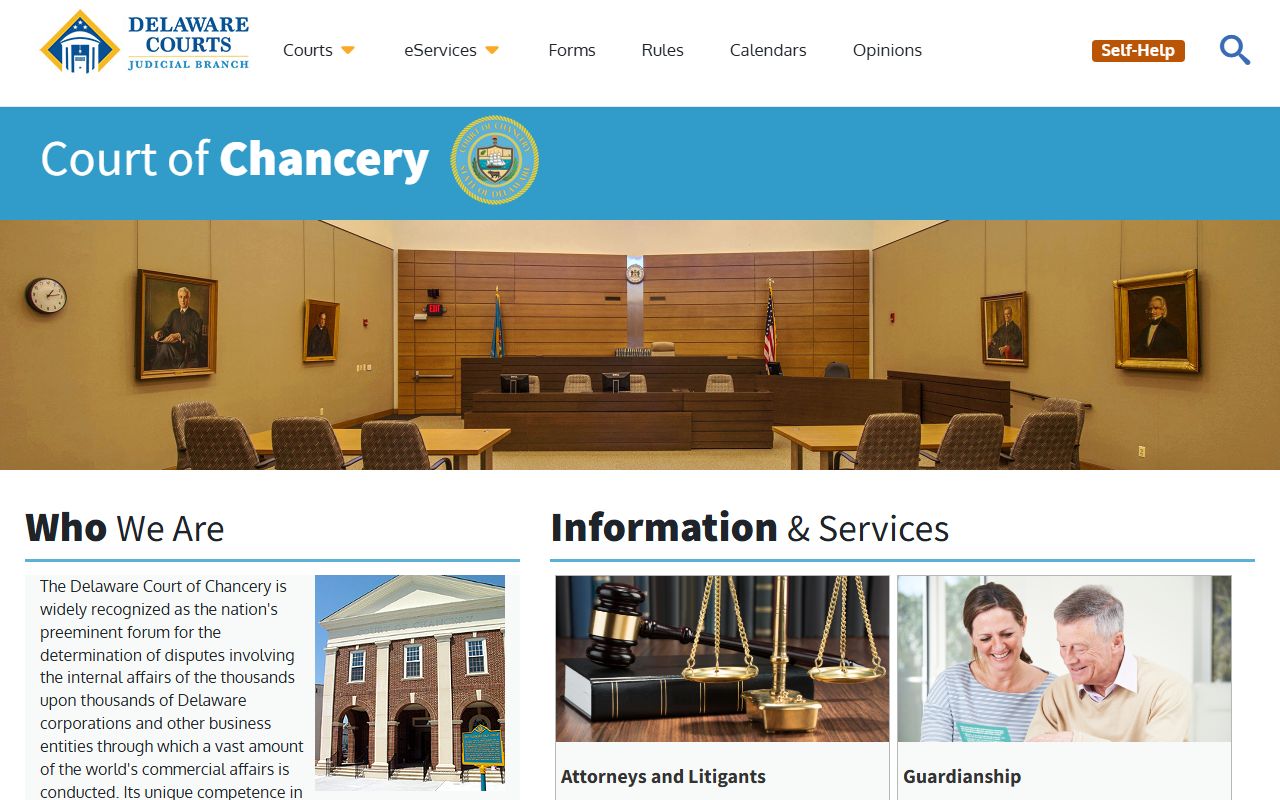
The image shows the Court of Chancery's home on the Delaware Courts site. The Chancery and Superior Court split is one of the most important things to understand about searching New Castle County court records, since the wrong court means the wrong docket.
| Court / Office | Address | Notes |
|---|---|---|
| Superior Court, New Castle County | Leonard L. Williams Justice Center, 500 North King Street, Wilmington, DE 19801 | Main felony and major civil trial court |
| Court of Chancery | Leonard L. Williams Justice Center, 500 North King Street, Wilmington, DE 19801 | Equity, corporate, trust, guardianship |
| Family Court | Leonard L. Williams Justice Center, 500 North King Street, Wilmington, DE 19801 | Divorce, custody, juvenile, PFA |
| Court of Common Pleas | Leonard L. Williams Justice Center, 500 North King Street, Wilmington, DE 19801 | Misdemeanors, preliminary hearings, limited civil |
What New Castle County Superior Court Hears
Superior Court has the widest case mix of any trial court in New Castle County. Felony criminal cases come here. Major civil cases come here. Civil jury trials happen here. The court also reviews some agency rulings and hears certain appeals from the Court of Common Pleas and Justice of the Peace Court.
- Felony criminal prosecution after lower-court arraignment.
- Civil tort claims, contract claims, and complex civil litigation.
- Civil jury trials for damages above lower-court limits.
- Appeals from boards, commissions, and some lower-court rulings.
- Mechanics liens, foreclosure-related actions, and judgment enforcement.
- Mass tort matters, including asbestos cases routed to the court.
Civil cases here are not the same as Chancery cases. Equity claims, corporate governance disputes, trust litigation, and guardianship belong in the Court of Chancery. Domestic cases belong in Family Court. Most small-dollar landlord-tenant or debt claims are handled in JP Court first. The result is a court mix where the Superior Court docket runs more like a felony and big-civil court than a catch-all county court.
Superior Court vs. Court of Common Pleas vs. Court of Chancery
The three adjacent New Castle County trial courts split work by case type. Superior Court takes the heaviest criminal and civil load. Court of Common Pleas takes misdemeanors and limited civil. Court of Chancery takes equity and corporate matters. Understanding the split matters when you search for the right docket.
| Superior Court | Court of Common Pleas | Court of Chancery | |
|---|---|---|---|
| Primary criminal role | Felony trials and felony jury trials | Misdemeanors and preliminary hearings | No criminal jurisdiction |
| Primary civil role | Major civil, complex civil, large damages | Civil claims within statutory limits | Equity, corporate, trust, guardianship |
| Jury trials | Yes, civil and criminal | Limited; bench-trial focused | No jury trials |
| Sample case | Defamation case N21C-08-063 | Misdemeanor traffic offense | Corporate fiduciary dispute |
| Appeal goes to | Delaware Supreme Court | Superior Court | Delaware Supreme Court |
Note: Court of Chancery is globally well known for corporate-law cases tied to Delaware-incorporated companies, but ordinary residents will likely deal with Superior Court, CCP, or JP Court rather than Chancery.
Searching New Castle County Superior Court Cases
Public civil docket searches for Superior Court run through Delaware CourtConnect, the state's "Judicial Case Database." CourtConnect lets users search by person, business, case type, judgment, or exact case ID. The disclaimer is critical: the data is "as is," the Civil Docket Report is not for official use, and certified records still come from the Prothonotary.
- Open the CourtConnect search home and read the disclaimer.
- Pick a search path: person/business/case-type, judgment search, or docket report by case ID.
- For a name search, enter the last name and narrow with first name, dates, or case type.
- For a docket report, type the case ID exactly, such as N21C-08-063.
- Use the partial last-name or phonetic checkboxes when spelling is unsure.
- Review case parties, filing date, type, and status on the case page.
- Request certified copies from the Prothonotary if needed for legal use.
A look at Title 10 of the Delaware Code shows where Superior Court's organization and jurisdiction live in statute.
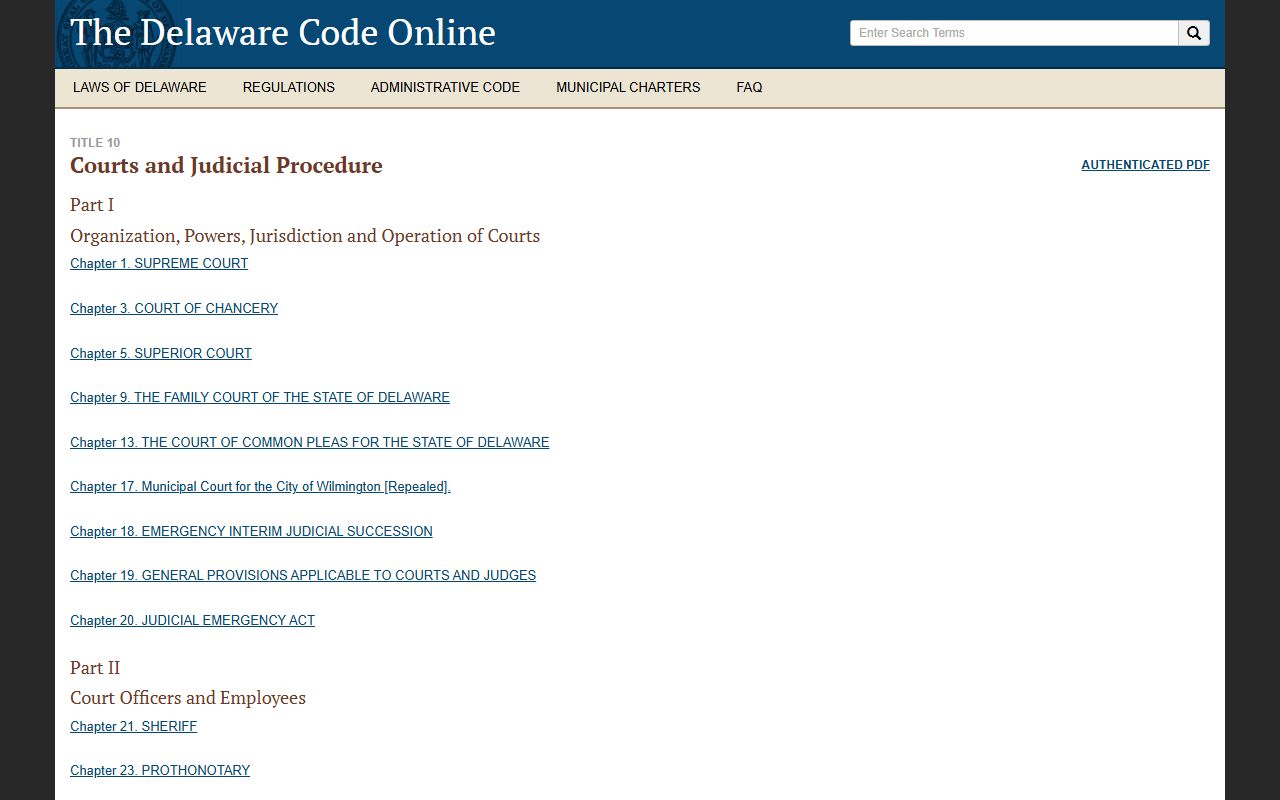
The image shows the Title 10 landing page in the Delaware Code. Title 10 covers courts and judicial procedure, including Superior Court jurisdiction and rules of practice that shape how cases move through the New Castle County docket.
How a Case Moves Through New Castle County Superior Court
Cases here follow distinct civil and criminal paths. The flow varies by claim type, but the high-level steps are stable. Each step in the flow may generate a docket entry on CourtConnect, so users tracking a case can follow it event by event.
Criminal flow: Arrest › JP Court or CCP first appearance › Indictment or Information › Superior Court arraignment › Pretrial › Trial › Sentencing › Appeal to Delaware Supreme Court.
Civil flow: Complaint filed with Prothonotary › Answer › Discovery › Motion practice › Mediation or pretrial › Trial (jury or bench) › Judgment › Appeal to Delaware Supreme Court.
Appeals into Superior Court: Appeal from JP Court or CCP › Notice of appeal › Record assembly › Briefing › Superior Court ruling › Further appeal to Supreme Court if allowed.
Note: A case may pause for sealed motions, protective orders, or interlocutory appeals; the public docket may not always reflect every internal court event.
The Superior Court Prothonotary
The Prothonotary is the Superior Court civil clerk. Civil filings, judgments, liens, civil appeals, and many enforcement records run through the Prothonotary's office. Certified copies and stamped documents come from this office, not from CourtConnect. The Prothonotary's work is the main reason CourtConnect is treated as a starting point rather than as the official record. Users with questions about a specific civil filing should contact the Prothonotary for the right form and current fee.
Probate records are not a Superior Court function. Estate administration runs through the Register of Wills for New Castle County, with Court of Chancery involvement for contested matters. Marriage licenses come from the New Castle County Clerk of the Peace. Knowing the right clerk saves time and avoids wasted fees.
Public Access and Restricted Filings
Public-record access in Delaware lives under 29 Del. C. Chapter 100, the state Freedom of Information Act, for agency records. Court records also follow court rules and other statutes. Some Superior Court records are limited, even though the case itself is in CourtConnect. Sealed filings, protective orders, juvenile-linked records, mental-health filings, and grand-jury materials are not public.
Criminal-history dissemination is separately governed by 11 Del. C. § 8513. Expungement of qualifying records runs under 11 Del. C. §§ 4372-4374. After expungement, public access to the affected court record is removed, and the docket may not reflect the underlying arrest the way it did before.
The CourtConnect disclaimer is itself part of the access framework. The disclaimer says commercial use of the data is prohibited and that email sent through the site does not count as filing or legal notice. For exact wording, see the live disclaimer page.
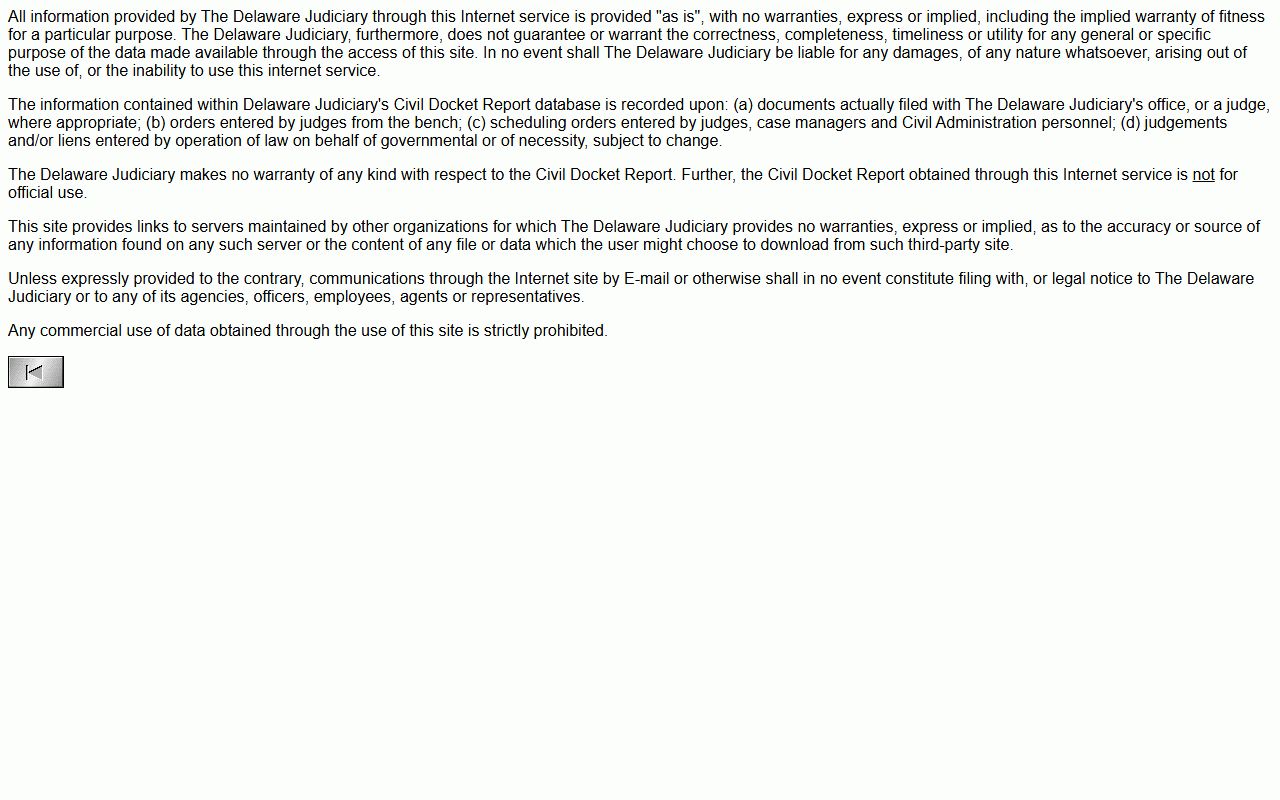
The image shows the official CourtConnect disclaimer. Anyone using CourtConnect for Superior Court research should read this page once, since the disclaimer controls how data may be used and warns that the docket report is not official.
Courthouse Contact Information
For in-person filings, hearings, and the Prothonotary counter, use the Leonard L. Williams Justice Center. Visitors should expect security screening at the entrance and should bring photo ID, case numbers, and any hearing notices.
Leonard L. Williams Justice Center
500 North King Street
Wilmington, DE 19801
Superior Court, Court of Chancery, Family Court, CCP
Note: Phone numbers and hours are published by court division on the Delaware Courts site; check the division page before driving downtown.