
What Probate Covers in New Castle County
Probate is the court-supervised process that moves a deceased person's assets to heirs and creditors. In New Castle County, the local probate office is the Register of Wills. The office helps families and attorneys with the papers needed to transfer a decedent's accounts, real estate, and personal property. It is not a separate elected probate court of its own. Estate work runs through the Register of Wills with oversight from Delaware's Court of Chancery system.
Probate also covers more than just a will. The office handles intestate estates when there is no will at all. It deals with small estates, inventories, accountings, short certificates, renunciations, bonds, claims, and the final close-out. Guardianship and conservatorship matters that touch a will, a trust, or a minor's estate may end up in Court of Chancery. Some matters are fully public. Others may be shielded if minors, sealed Chancery files, or sensitive medical data are in play.
Probate Terms Defined
The same words show up in almost every estate file. A quick read of the terms below makes a probate filing far easier to follow. Each term carries a fixed legal meaning under Delaware law.
- Testator
- The person who made the will. The testator's death starts the probate clock.
- Executor
- The person named in the will to carry out its terms. Once approved by the Register of Wills, the executor is the personal representative.
- Intestate
- Dying without a valid will. State law sets the order of heirs and shares when no will exists.
- Guardianship
- A court order naming a guardian for a minor or incapacitated adult. Guardianship may cover person, property, or both.
- Conservatorship
- A court order placing a person's finances under another party's care, often used when the protected person cannot manage assets alone.
- Short certificate
- The official paper that proves a personal representative has authority to act for the estate. Banks and title companies ask for it.
How to Search New Castle County Probate Records
An estate search begins with the basic facts of the case. The Register of Wills holds the file and can confirm whether an estate has been opened. Members of the public can request copies of public estate documents under Delaware access rules. The lead-in to this page comes from the office's own forms set, which is published online.
Below is the official probate forms page from the New Castle County Register of Wills. See the New Castle County Register of Wills probate forms page for the live form set.
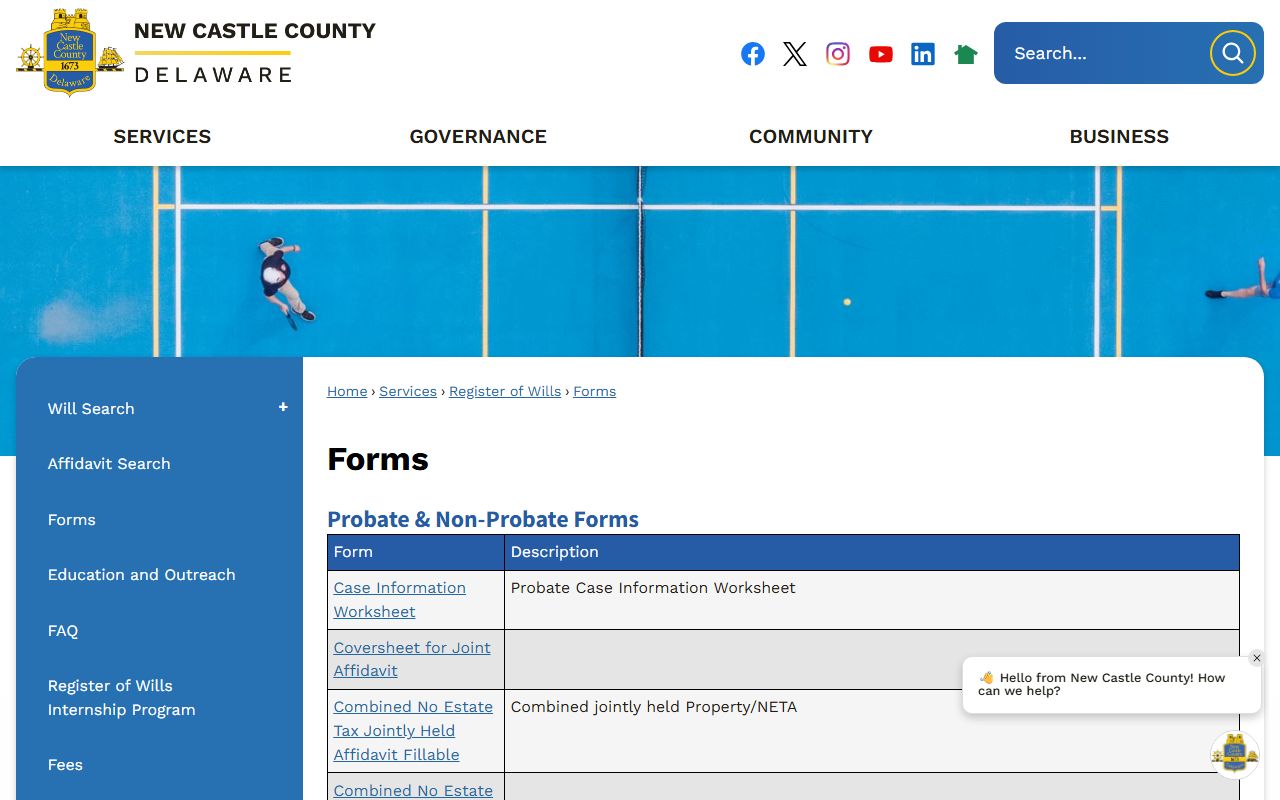
The forms page shows the petitions, inventories, and accounting templates used to open, run, and close an estate in New Castle County.
- Gather the decedent's full legal name, last address, and date of death.
- Contact the Register of Wills and confirm whether an estate file already exists.
- Identify the estate number when known. That speeds every request.
- Ask for the document type you need: certified short certificate, plain copy of the will, inventory, or accounting.
- Pay the office fee using a method the office accepts on the day of the request.
- Pick up, mail, or scan the file as the office allows for that record type.
Probate Search and Copy Request Fields
A probate request to the Register of Wills follows a short field set. Bring the data ready or you may need to come back. The table below tracks the field set that drives a probate search or copy order.
| Field | Type | Required | Notes |
|---|---|---|---|
| Decedent name | Text | Yes | Full legal name preferred |
| Date of death | Date | Helpful | Narrows the estate file |
| Estate number | Text | Optional | Use exact file number if known |
| Requester contact | Text | Yes for copies | Name, phone or email, address |
| Copy type | Select | Yes for copies | Plain, certified, short certificate |
| Relationship to estate | Text | Conditional | Heir, executor, attorney, or other party |
| Payment | Fee | Yes | Confirm Register of Wills fee schedule at the office page |
New Castle County Probate Workflow
An estate runs along a known track. The Register of Wills sets the order. The list below mirrors the steps from petition to close.
- Confirm the decedent lived in New Castle County or owned Delaware property that needs probate.
- Contact the Register of Wills or pull forms from the county probate forms page.
- Gather the death certificate, the original will if any, asset data, heir data, and ID for the petitioner.
- Open the estate and qualify as personal representative.
- Obtain short certificates so banks and title agents will work with the estate.
- File the inventory and accounting documents by the deadlines set by the office.
- Provide creditor notice as required by state law and resolve claims, debts, and taxes.
- Distribute assets to the heirs or beneficiaries.
- Close the estate after the final accounting clears.
Note: Delays often come from missing original wills, sibling disputes, out-of-state real estate, unknown creditors, or late accountings.
Delaware Probate and Related Statutes
Estate work in Delaware draws on more than one code title. Title 12 governs decedents' estates, wills, and trusts. Title 13 governs domestic relations and adoption. Adoption files in particular are sealed, and many family records that touch a probate may also be restricted. The link below pulls up the full domestic relations and adoption statutes set used across these files. See Title 13 of the Delaware Code for the statute set.
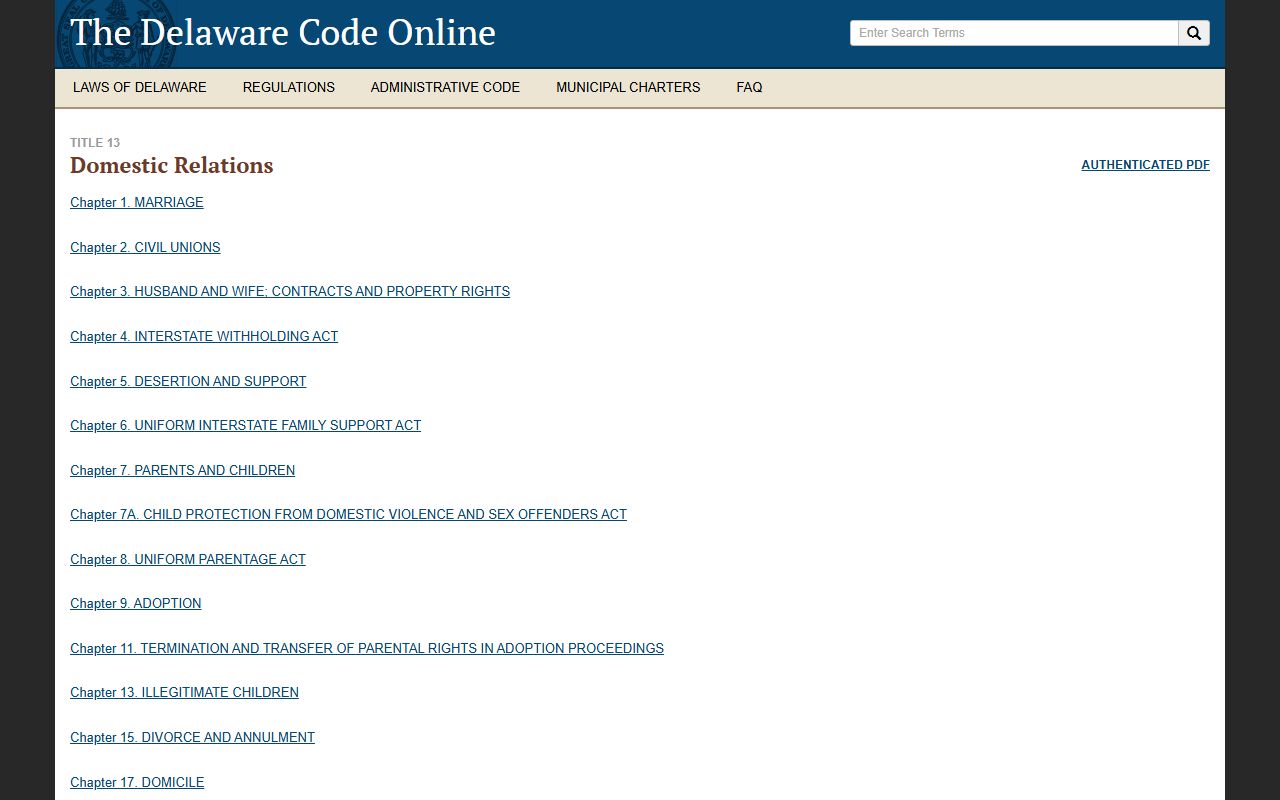
The Title 13 page is the official source for Delaware adoption and domestic relations rules that may touch a probate file when minors, family status, or stepchild questions come up.
Probate Contacts in New Castle County
Two offices anchor probate work in New Castle County. The Register of Wills runs the local estate desk. The Court of Chancery hears contested estates and equity matters. Each card below points to the right office.
New Castle County Register of Wills
800 North French Street
Wilmington, DE 19801
Estate opening, short certificates, inventories, accountings
Delaware Court of Chancery (New Castle County)
Leonard L. Williams Justice Center
500 North King Street
Wilmington, DE 19801
Equity, trusts, guardianships, contested estate matters
Probate Filing Fees
Probate fees in New Castle County are set by the Register of Wills and may shift with each fee schedule update. The office page is the live source for current amounts. Confirm the Register of Wills fee schedule at the office page before you file.
| Item | Amount |
|---|---|
| Open an estate | Set by Register of Wills; confirm at the office |
| Short certificate | Set by Register of Wills; confirm at the office |
| Certified copy per page | Set by Register of Wills; confirm at the office |
| Guardianship or related Chancery filing | Set by Court of Chancery; confirm at the court page |
| Fee waiver | May be available for qualifying filers |
Note: Estate value can also drive certain fees, so bring an asset summary when you open the estate.
What New Castle County Probate Records Show
An open estate file is built from many pieces. A typical file holds the petition for probate, the will if one exists, the order admitting the will, letters appointing the personal representative, an inventory of assets, periodic accountings, creditor claims, tax filings tied to the estate, and the order that closes the case. Real estate transfers, life insurance routing, and bank account movement may all show up across these papers.
Public access to an estate file is broad once the estate is opened. Heirs, creditors, attorneys, and the public can review most filings. Sealed Chancery matters, juvenile guardianship files, and minor beneficiary records may be restricted. Personal data such as Social Security numbers and full account numbers should be redacted under court rule.
Death Records and Vital Statistics
A probate request often runs side by side with a death record request. Death certificates come from the Delaware Office of Vital Statistics. The estate file uses the death certificate as a key opening paper. The link below points to the state vital statistics page for death certificate orders.
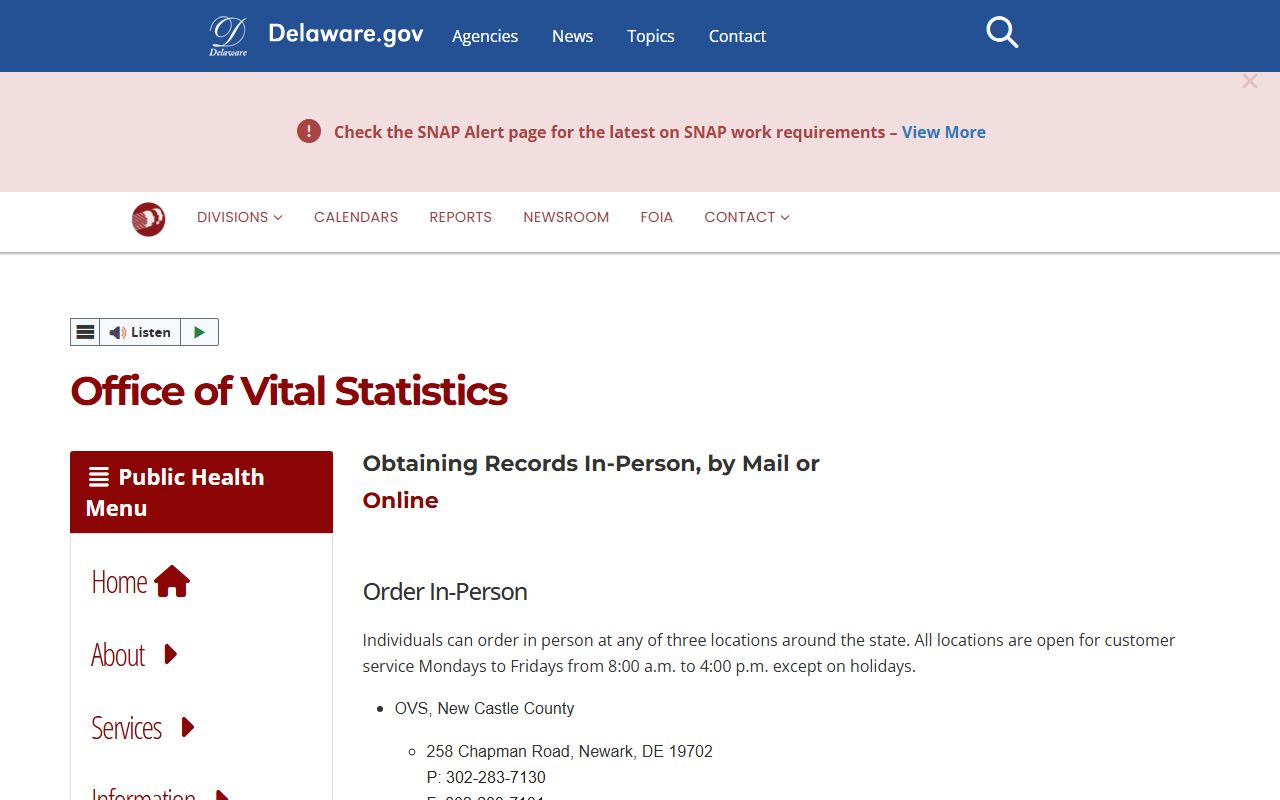
The vital statistics page lets families order certified death certificates that the Register of Wills will ask for when an estate is opened.
Restricted Probate Records
Most estate filings are public. Some are not. Adoption files tied to a will, sealed Chancery orders, minor guardianship files, and protected medical data are routinely restricted. Mental health and capacity records that come up during a guardianship case may be filed under seal. A protective order in a related family case may also limit access to estate filings that touch a minor or victim. Ask the office before you order a copy if any flag may be in play.