
About the New Castle County Prothonotary
The Prothonotary is the civil docket clerk for the Delaware Superior Court in New Castle County. Delaware splits clerk duties by court and record type, so the Prothonotary is not a one-stop county clerk. The office handles civil filings, judgments, and liens. It does not handle wills, marriage forms, or land deeds. Those go through the Register of Wills, the Clerk of the Peace, and the Recorder of Deeds.
The office sits in the Leonard L. Williams Justice Center in downtown Wilmington. Clerks at the counter take new filings, mark exhibits, log docket entries, and accept certified-copy requests. Most case papers are filed by lawyers through the court's electronic system. Self-represented filers can still walk in, file by mail, or use the counter for short certified-copy jobs.
Superior Court Prothonotary, New Castle County
Leonard L. Williams Justice Center
500 North King Street
Wilmington, DE 19801
Hours and direct numbers are posted at courts.delaware.gov/superior.
What the Prothonotary Does in New Castle County
The job is narrow and important. The Prothonotary docks new civil complaints, time-stamps each filing, books judgments, and keeps the orders a judge signs. The office also issues writs, manages appeals from lower courts, and tracks liens that attach to property. The clerk does not give legal advice. Staff can show you how to file, but they cannot tell you what to file or whether your case is strong.
- Open new Superior Court civil cases and assign case IDs.
- Hold civil pleadings, motions, and judge-signed orders.
- Book and release civil judgments and liens.
- Issue writs, summonses, and process for service.
- Handle appeals from Court of Common Pleas and many state boards.
- Print certified copies of filings, judgments, and orders.
The clerk also runs the public counter for case lookups when CourtConnect is not enough. Sealed files, restricted juvenile matters, and Family Court records do not move through this office. Family records go through Family Court. Criminal felony files run through Superior Court's criminal division, which is a separate counter.
CourtConnect: The Public Civil Docket Portal
Delaware's free public docket tool is CourtConnect. It is tied to Prothonotary records and lets the public look up civil cases, judgments, and case parties. The portal is informational only. Its disclaimer states that the data are provided as-is, that the Civil Docket Report is not for official use, and that commercial use is barred. Certified copies still come from the clerk.
The search uses simple text fields. You can search by person name, by business name, by case type, or by a case ID for a docket report. The form supports phonetic search and partial last-name search when a spelling is unclear. Date range filters help narrow long result lists. Sealed and confidential cases will not appear in public output. For the field-by-field breakdown of the name search, see the table below.
| Field Label | Type | Required | Notes / Format |
|---|---|---|---|
| Phonetic Search | Checkbox | No | Helps when name spelling is uncertain. |
| Partial Last Name | Checkbox | No | Allows last-name fragments. |
| Last Name or Company Name | Text | Yes | Max 60 characters. |
| First Name | Text | No | Max 15 characters. |
| Middle Name | Text | No | Max 15 characters. |
| Beginning Case Filing Date | Date | No | Format DD-MON-YYYY. |
| Ending Case Filing Date | Date | No | Format DD-MON-YYYY. |
| Case Type | Dropdown | No | Defaults to ALL. Includes civil actions, judgments, liens, foreclosures, debt cases, and more. |
The clerk structure that supports CourtConnect ties back to the same office that books land judgments and corporate liens. For background on the split between county offices and state court offices, see the Recorder of Deeds source page linked below.
The New Castle County Recorder of Deeds page shows how land records sit next to Prothonotary civil records but are kept by a different office.
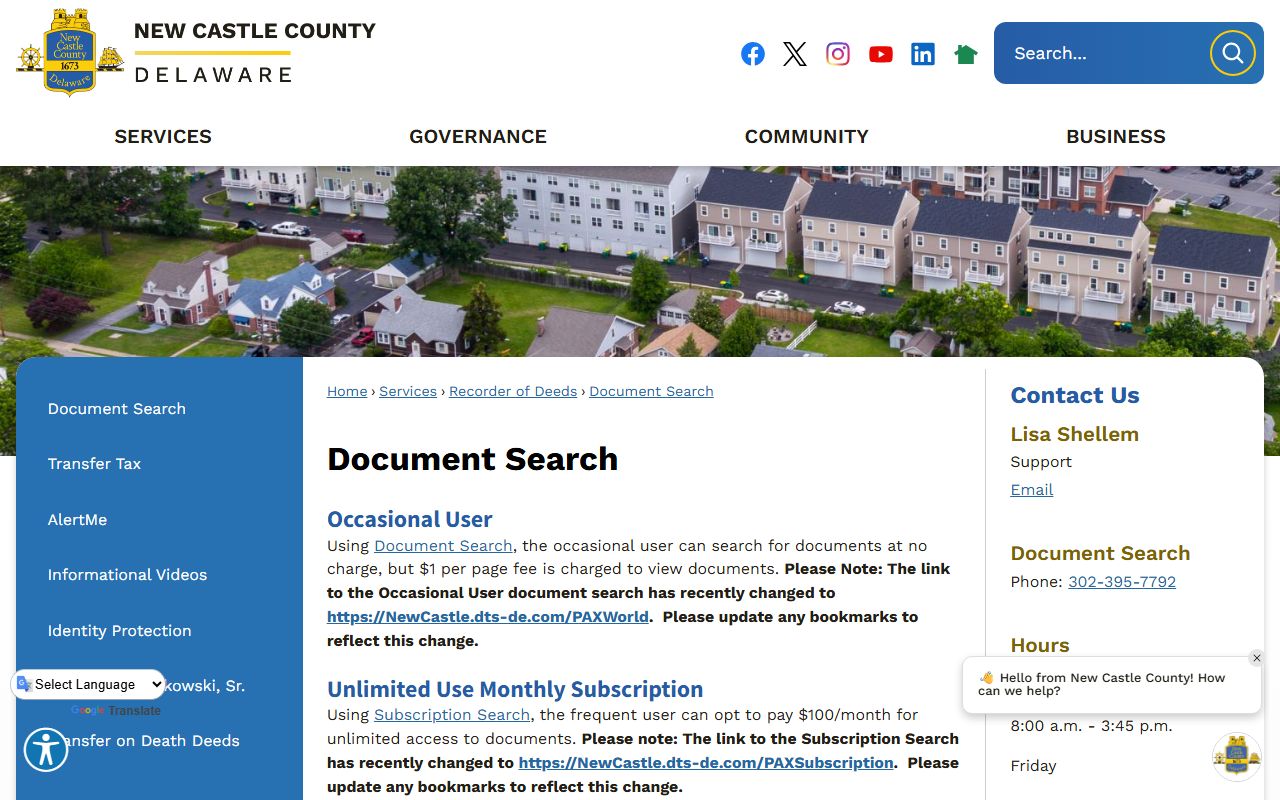
The Recorder of Deeds page makes it clear that mortgages, deeds, and other land filings do not pass through the Prothonotary. Judgment liens that attach to land, though, do start with the Prothonotary and are then noted in land records when needed.
How to Request a Certified Copy
Certified copies are paper copies that carry a clerk's stamp and signature. Courts, banks, lenders, title companies, and some federal agencies require certified copies. A plain print from CourtConnect will not be accepted as a certified record. The job is short, but you need the case ID and the right fee.
- Find the case ID using CourtConnect or your old paperwork. The case ID looks like N21C-08-063.
- Pick the document you need. Common picks are the complaint, the final order, a judgment, or a notice of lien.
- Fill out a copy request. Some clerks take a written note with the case ID, the document name, and the number of copies.
- Bring or send the fee. The Prothonotary fee schedule is set by court rule and posted at the counter and on Delaware Courts pages.
- Pick up at the counter or have the copy mailed. Allow extra days for mail requests.
Note: Certified copies are required for legal use; plain CourtConnect prints do not count as official records.
Records Request Form Fields
Most clerks accept a short written request. You do not need a long form. You do need the right facts. The table below shows the fields a Prothonotary clerk uses to pull and stamp the correct papers.
| Field | Required | Notes |
|---|---|---|
| Case Number | Yes | Use the format from CourtConnect, such as N21C-08-063. |
| Party Names | Yes | Helps the clerk verify the file when the case ID is partial. |
| Document Type | Yes | Complaint, order, judgment, lien, motion, or notice. |
| Filing Date or Range | No | Use when there are many filings of the same name. |
| Number of Copies | Yes | Each certified copy carries its own fee. |
| Certified or Plain | Yes | Certified copies need a clerk stamp and signature. |
| Requester Name and Contact | Yes | Address, phone, or email for pickup or mail. |
| Payment Method | Yes | Confirm what forms of payment the office takes. |
New Castle County Prothonotary Fees
The exact dollar amounts are set by Delaware court rule and the Prothonotary's posted fee schedule. The list below shows the fee types you will see, not invented dollar amounts. Always check the current fee schedule on the Delaware Courts site before sending payment. Filing fees and copy fees can change.
| Item | Notes |
|---|---|
| New civil complaint filing | Set by Superior Court rule; varies by case type and amount in controversy. |
| Judgment entry | Booked when a judgment is filed or transferred for execution. |
| Plain copy per page | Per-page copy fee for non-certified prints. |
| Certified copy per page | Per-page rate plus a certification fee. |
| Certification stamp | Per-document stamp fee for the clerk's seal and signature. |
| Writs and process | Issued for service and execution; fee varies by writ type. |
| Search fee | Charged when the clerk runs a record search on your behalf. |
| Mail handling | Some offices add a small mail-out fee. |
Note: Exact fees and accepted payment forms are listed on Delaware Courts and at the Prothonotary counter.
Court Records and Delaware FOIA
Delaware has a state Freedom of Information Act under 29 Del. C. Chapter 100. It covers most state and county agency records. Court records have their own access rules under court policy and statute. That means the Prothonotary does not always treat a file like a FOIA request. Sealed files, juvenile records, and certain Family Court records are not open the way agency records are. For non-court state and county records, the Delaware FOIA portal is the right starting point.
The lead-in to the FOIA portal shows how state agencies route record requests.
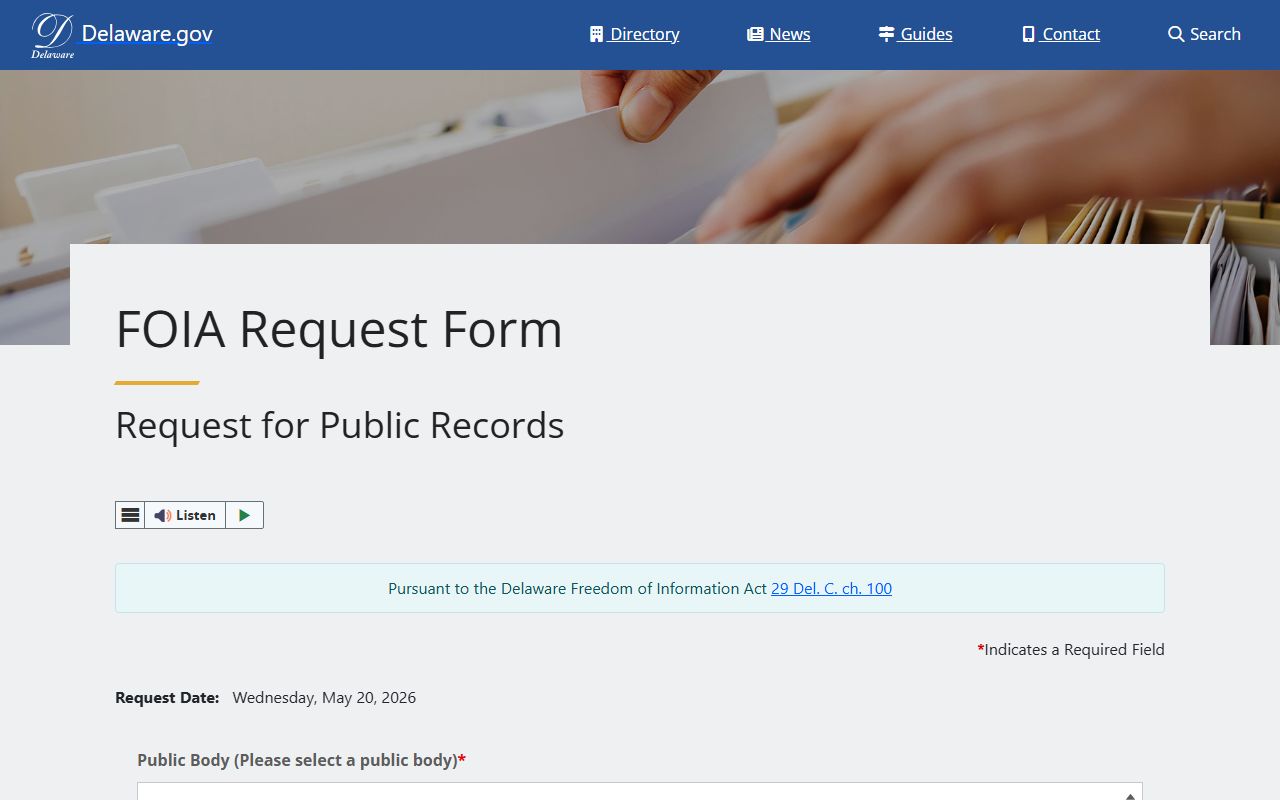
FOIA pages and court access pages live side by side, but they follow different rules. Court fee waivers, redaction tests, and response timelines are set by court orders, not by FOIA alone.
Other Clerk Offices in New Castle County
The Prothonotary is one of several offices that act like a clerk in Delaware. Each one keeps a different set of records. Picking the right office is the first step in most record hunts. The list below covers the main ones tied to New Castle County. For probate, see the Register of Wills page.
- Register of Wills for wills, estates, and short certificates.
- Clerk of the Peace for marriage licenses.
- Recorder of Deeds for land records and mortgages.
- Court of Chancery for equity, trust, guardianship, and contested estate matters.
- Family Court for divorce, custody, support, and PFA orders.
Mail, In-Person, and Online Filings
Most filings reach the Prothonotary in three ways. Lawyers and frequent filers use the court's electronic system. Self-represented filers may walk in to the Wilmington counter. Mail still works for many filings and for certified-copy requests when you can wait a few days. Each path needs the same basic facts: the case ID, the names, the document, and the right fee.
Filings tied to active hearings should not be mailed at the last minute. If a deadline is close, walk the document to the counter or use the electronic system if you have access. Lost mail can be a real problem when a motion is due. Read the rule on filing methods before you send anything that is time-sensitive.