
How to Search New Castle County Court Records
The main public portal is Delaware CourtConnect, titled "State of Delaware Courts Judicial Case Database." It covers civil dockets, judgments, and case lookups across Superior Court, the Court of Common Pleas, Justice of the Peace Court, and other state-court divisions. The first screen offers three search paths. One is search by person, business, or case type. Another is search for judgments. The third is a direct docket report by case ID. Users must accept a disclaimer before any field appears.
Before you start, gather what you have. A last name or business name is the minimum. A first name, middle name, and a date range narrow results fast. The exact Case ID is the best key, in the format observed on the Superior Court docket sample (for instance, N21C-08-063). The portal does not give certified records. Treat results as informational and pull official copies from the right clerk.
The lead-in below shows the official Delaware Courts homepage, where every court division links out from one place. View the Delaware Courts homepage to see how the judiciary frames public access.
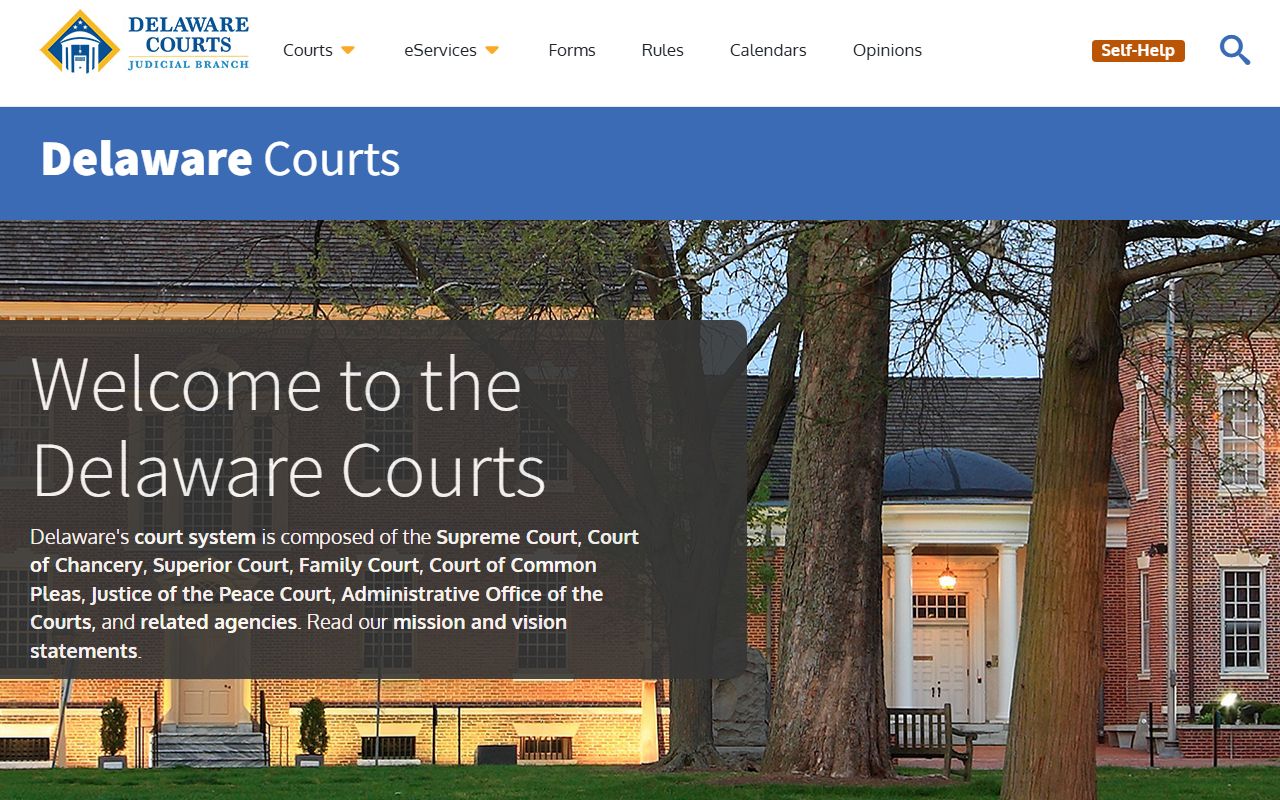
That homepage is the parent hub. From there, users can move to CourtConnect or any individual court page that handles New Castle County matters.
- Open CourtConnect at the search home and accept the disclaimer.
- Pick the right search path. Use person, business, or case type when the case number is not known. Use the docket report search when the Case ID is known.
- Enter the last name or business name. Add a first name, middle name, or filing-date range to cut down hits.
- Use the "Check for Phonetic Search" or "Check for Partial Last Name" checkboxes when spelling is shaky.
- Pick a case type from the dropdown if you want only civil actions, JP landlord-tenant, judgments, or another category.
- Run the search, then click into a case for parties, attorneys, and docket entries.
- For a certified copy or stamped filing, take the Case ID to the right court clerk. CourtConnect is not an official record.
The screenshot below shows the CourtConnect search home itself. Open the live page on the Delaware CourtConnect search to test a real lookup.
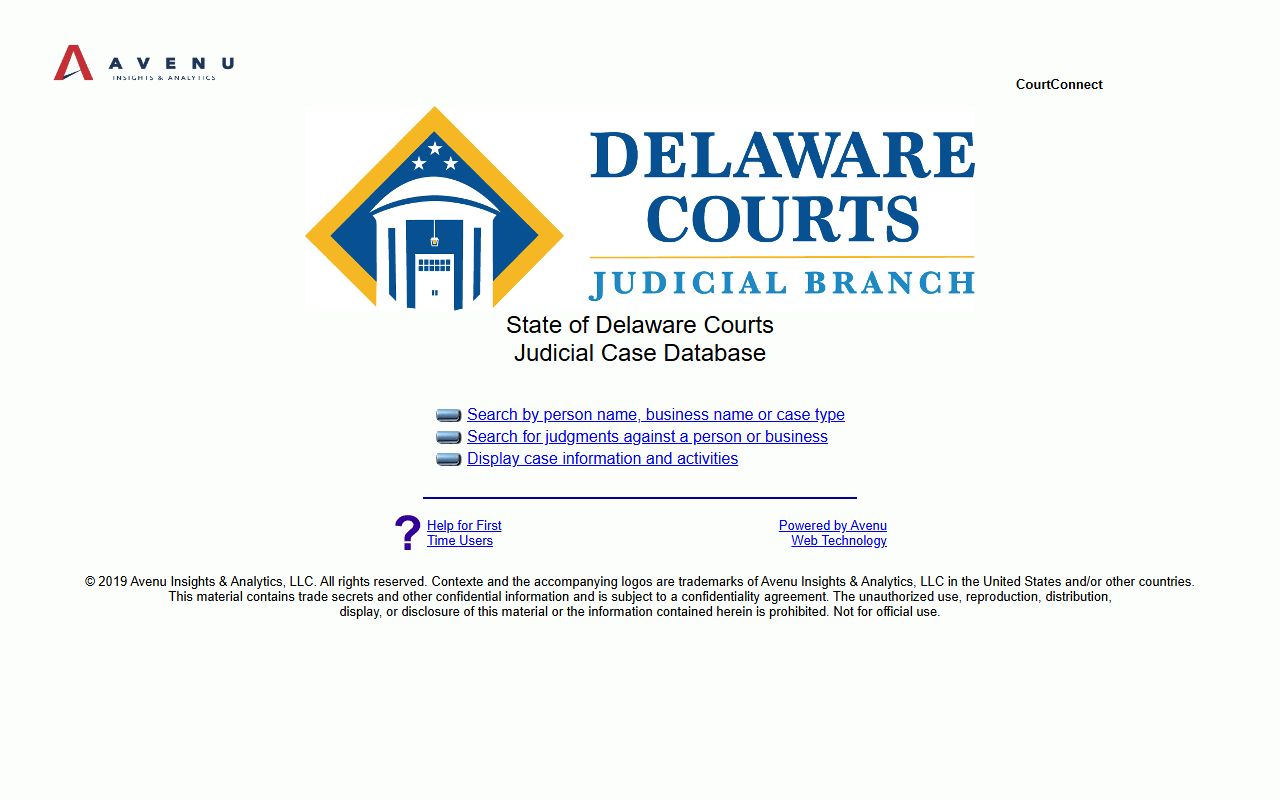
The portal lists each search path with the same look and feel. Pick the one that matches what you know before you click in.
CourtConnect person/case-type search fields:
| Field | Type | Required | Notes |
|---|---|---|---|
| Check for Phonetic Search | Checkbox | Optional | Helps when name spelling is uncertain |
| Check for Partial Last Name | Checkbox | Optional | Permits a partial last-name search |
| Last Name or Company Name | Text | Yes | Up to 60 characters |
| First Name | Text | Optional | Up to 15 characters |
| Middle Name | Text | Optional | Up to 15 characters |
| Beginning Case Filing Date | Date | Optional | Format DD-MON-YYYY |
| Ending Case Filing Date | Date | Optional | Format DD-MON-YYYY |
| Case Type | Dropdown | Optional | Defaults to ALL; many civil and JP options |
The New Castle County Judicial System
Delaware runs a unified statewide court system. New Castle County is not its own court district. The Superior Court is the main general-trial court. It hears felonies, major civil suits, civil jury trials, and many appeals from boards and lower courts. Below it sit the Court of Common Pleas for misdemeanors and limited civil work, plus the Justice of the Peace Court for small claims, landlord-tenant, debt, and traffic. The Family Court takes divorce, custody, support, abuse cases, and juvenile delinquency.
The Court of Chancery sits to the side as Delaware's equity court. It handles trust, guardianship, corporate, and contested estate matters. The Supreme Court of Delaware is the court of last resort. Appeals from New Castle County's trial courts can land there, depending on case type and statute. New Castle County is the most populous of Delaware's three counties. Most state court work for the county runs out of one building in downtown Wilmington.
Case flow: Justice of the Peace Court › Court of Common Pleas › Superior Court › Supreme Court of Delaware. The Court of Chancery sits separately for equity, trust, and corporate matters.
The Superior Court page shows the look and the court's published contact info. The image below is a screenshot of that page.
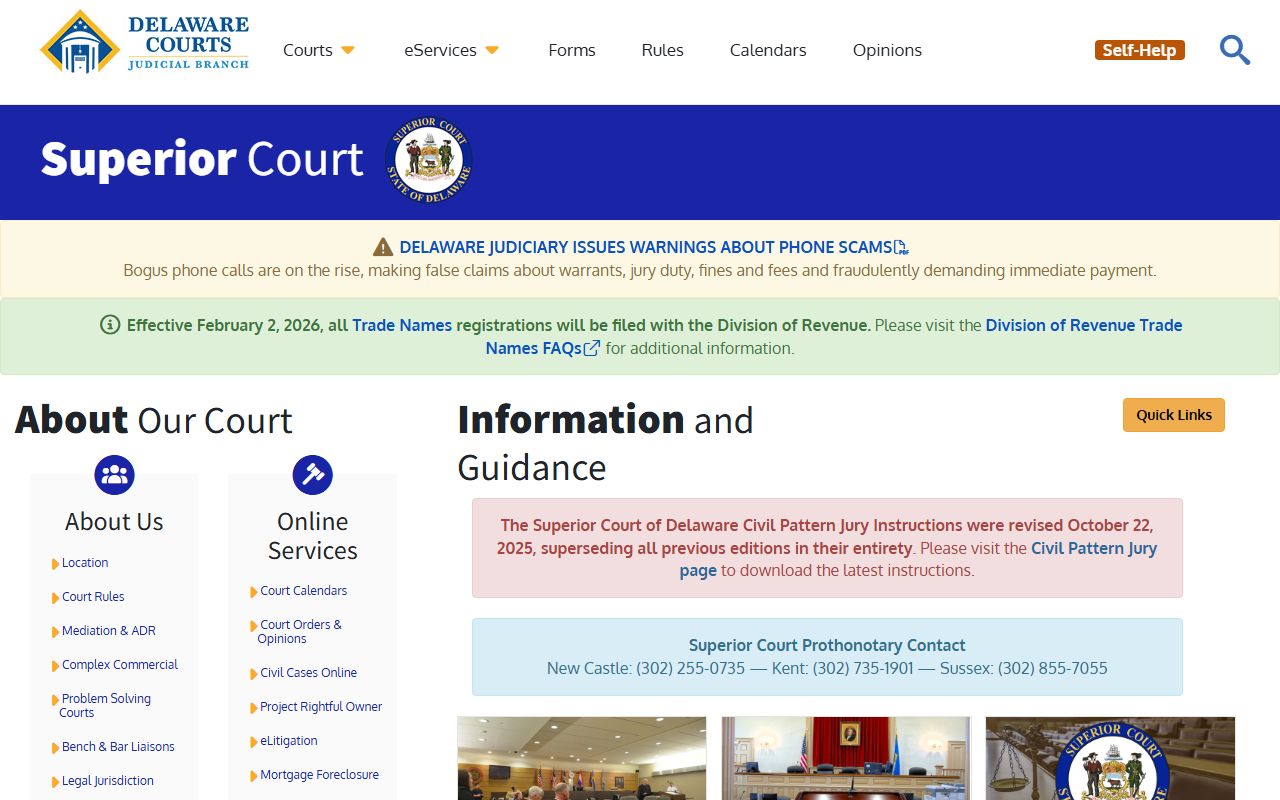
Superior Court is the right court for felony cases and high-value civil suits filed in New Castle County.
| Court | Jurisdiction | Case Types |
|---|---|---|
| Supreme Court of Delaware | Final appellate review | State appeals, attorney discipline, court rule authority |
| Court of Chancery | Equity, statewide | Trust, guardianship, corporate disputes, contested estates |
| Superior Court | General trial, statewide | Felonies, major civil suits, civil jury trials, agency appeals |
| Family Court | Domestic and juvenile | Divorce, custody, support, PFA, juvenile delinquency |
| Court of Common Pleas | Intermediate trial | Misdemeanors, preliminary hearings, lower-value civil |
| Justice of the Peace Court | Lower trial | Small claims, landlord-tenant, debt, traffic |
New Castle County Courthouses
The main building for state court work in New Castle County is the Leonard L. Williams Justice Center at 500 North King Street in downtown Wilmington. It is the day-to-day home for Superior Court, the Court of Common Pleas, Family Court, and the Court of Chancery's New Castle sittings. Most users still call it the New Castle County Courthouse, though the formal name honors a Delaware lawyer and jurist. Two blocks north on French Street sits the New Castle County Government Center, where the Clerk of the Peace and the Register of Wills run their own counters. Marriage licenses and probate filings go there, not to the Justice Center.
For Family Court matters, see the Family Court page. Court of Common Pleas filings route through the Court of Common Pleas page. JP Court cases route through the Justice of the Peace Court page. The look of each court page is captured below. View the Court of Common Pleas site as your starting point.
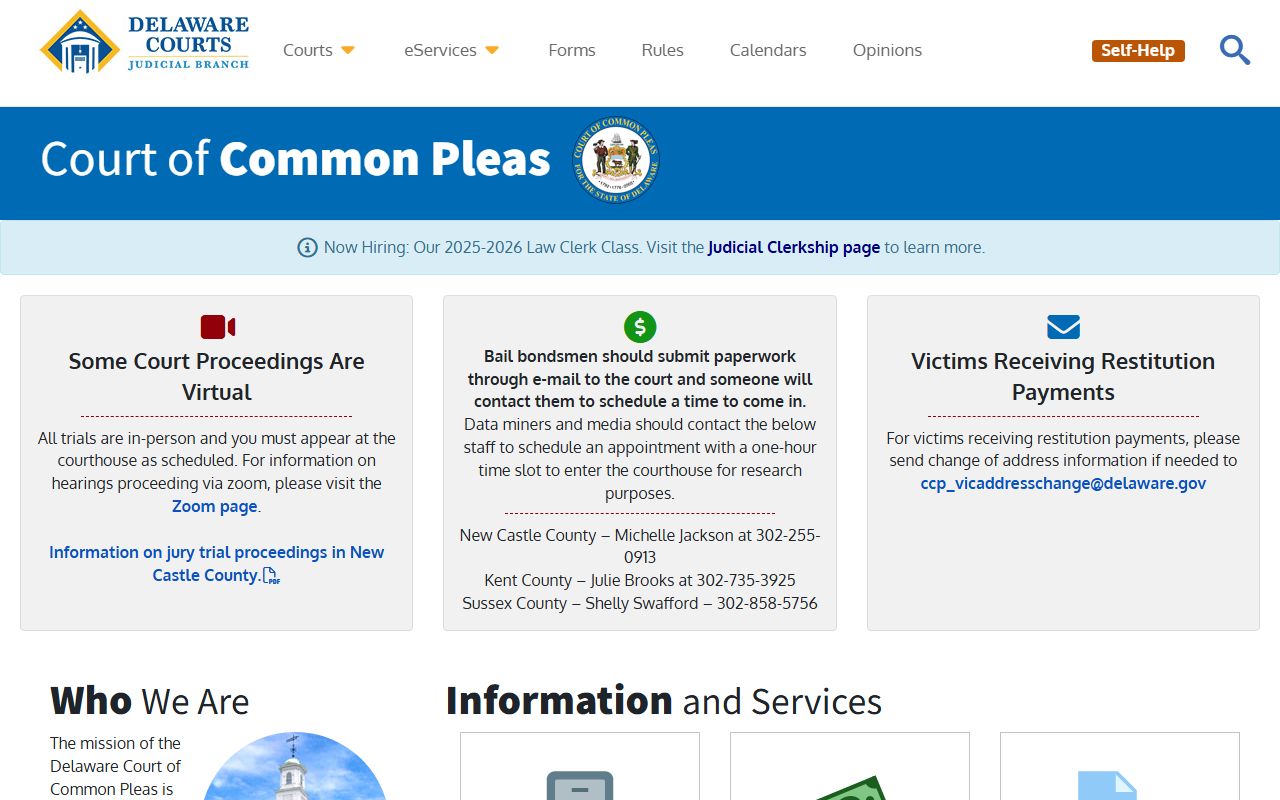
The Common Pleas page links to forms, divisions, and case-payment resources for misdemeanor and limited civil filings.
The Family Court page is the right entry point for divorce, custody, and protection-from-abuse work. Open the live page at the Delaware Family Court link.
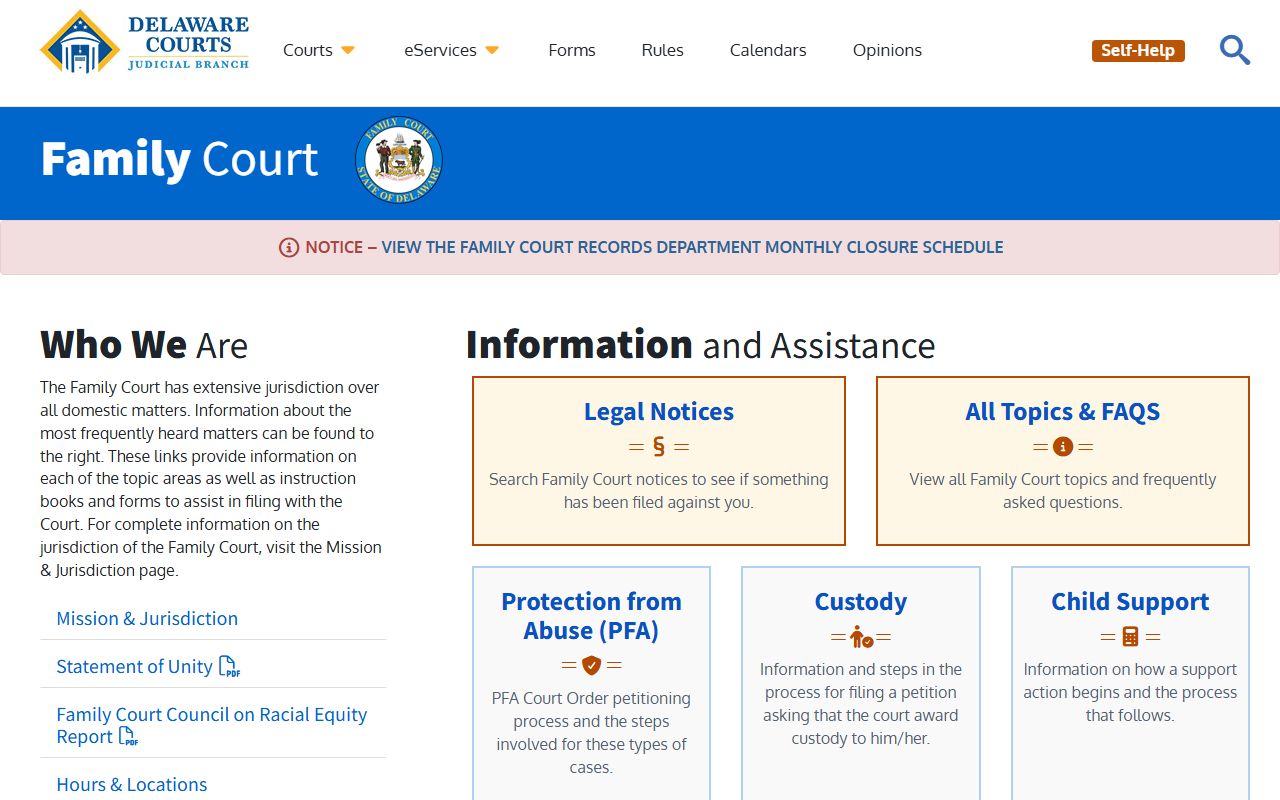
Family Court schedules, forms, and contact info all begin at that statewide page.
Leonard L. Williams Justice Center
500 North King Street
Wilmington, DE 19801
See division pages for direct lines
New Castle County Register of Wills
800 North French Street
Wilmington, DE 19801
County government contact
New Castle County Clerk of the Peace
800 North French Street
Wilmington, DE 19801
County government contact
Types of Court Records Available in New Castle County
The county's court files cover a wide span. Civil, criminal, family, probate, traffic, and juvenile cases each leave a paper trail at a different court. Civil records sit in Superior Court, the Court of Common Pleas, the Court of Chancery, or the Justice of the Peace Court depending on the dollar value and claim type. Criminal cases run through Superior Court for felonies, Common Pleas for many misdemeanors, and JP Court for the lowest-level offenses. Family Court holds divorce, custody, and juvenile files. Probate sits with the Register of Wills.
Each court level produces its own kind of record. Superior Court files often include complaints, motions, judgments, jury verdicts, and sentencing orders. JP Court files lean toward landlord-tenant orders, default judgments, and traffic dispositions. Family Court files cover orders, support calculations, and PFA enforcement. The court records page walks through each record type in detail.
- Criminal records - Charging documents, pleas, dispositions, and sentences from Superior Court, Common Pleas, and JP Court. See the criminal records page for more.
- Civil records - Complaints, judgments, liens, and Chancery filings. Search public dockets at the court dockets page.
- Family records - Divorce decrees, custody orders, and support files held by Family Court. See the marriage and divorce records page.
- Probate records - Wills, estate files, inventories, and short certificates held by the Register of Wills. See the probate records page.
- Traffic records - Citation files held by JP Court and other courts; separate from the DMV driver record.
- Warrant records - Active arrest, bench, and search warrants. See the warrant records page.
What New Castle County Court Records Show
A docket page in CourtConnect shows a clean set of fields. The Case ID uses a county-coded format. A New Castle Superior Court civil case looks like N21C-08-063. The "N" marks the county, "21" the year, "C" the case-type code, and the rest is sequence data. The caption shows the plaintiff and defendant. The case type is coded plus written out, such as "CG - DEFAMATION." The status reads as a code plus text, such as "CLOSED - CLOSED." Parties, attorneys, hearing schedules, and docket entries follow on the same page.
The JP Court site is the lookup point for many low-level cases. The Justice of the Peace Court page is the entry point.
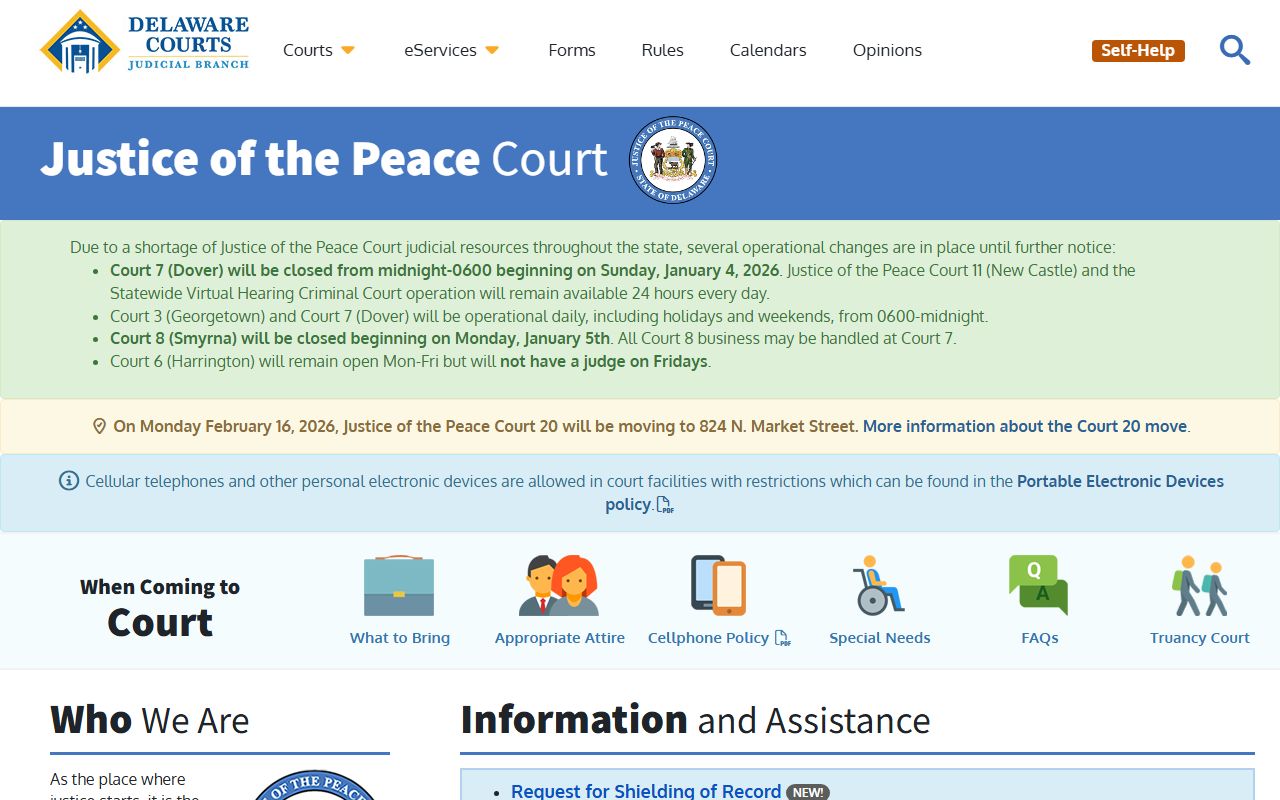
JP Court pages cover landlord-tenant, small claims, and traffic processes that round out the records picture.
| Field | What It Shows |
|---|---|
| Case ID | County code, year, case-type code, and sequence number (sample: N21C-08-063) |
| Filing Date | Date the case opened, shown with weekday and month |
| Parties | Plaintiff, defendant, attorney for each side, plus any commissioner |
| Case Type | Code plus written description, such as CG - DEFAMATION |
| Status | Open, closed, transferred, stayed, or sealed |
| Docket Entries | Filings, motions, orders, judgments, writs, and returns of service |
| Hearing Schedule | Date, time, courtroom, event type, judge, or commissioner |
| Financial Data | Fines, costs, restitution, judgment amount, bond, satisfaction |
Public Access Laws for New Castle County Court Records
Delaware's public records framework lives in Title 29, Chapter 100 of the Delaware Code. That chapter is the state Freedom of Information Act. It applies to agency records held by public bodies, including New Castle County offices. Court records sit in their own track. Judicial records, sealed filings, Family Court files, juvenile cases, adoption, grand-jury material, mental-health files, and criminal-history dissemination all run under separate statutes and court rules. The Delaware Department of Justice gives FOIA guidance and handles some agency-denial petitions.
The courts themselves use court rules, administrative directives, and clerk procedures to decide what is open. CourtConnect's own disclaimer says docket data are not certified. Treat the portal as a research tool. Treat the clerk's office as the source of record for anything you need to file, prove, or rely on. The public records page walks through filing a FOIA request.
Key Statutes:
29 Del. C. § 10001 - Sets the state FOIA policy that citizens shall have reasonable access to public records and meetings.
29 Del. C. § 10003 - Spells out the right to examine and copy public records, plus the basics of response timing.
29 Del. C. § 10003B - Allows agencies to charge reasonable copy, administrative, and staff fees for FOIA requests.
11 Del. C. § 4372 - Lists mandatory expungement eligibility for certain criminal records.
11 Del. C. § 8513 - Controls criminal history record information dissemination, separate from court docket access.
Records That Are Restricted or Confidential
Not every record is open. Juvenile delinquency, truancy, dependency, neglect, and child-welfare files are restricted. Adoption files are confidential by statute. Family Court divorce may have public components, but custody, support, and PFA filings are often limited. Sealed or expunged criminal records sit under 11 Del. C. §§ 4372-4374. Once a case is expunged, the record drops out of ordinary public access. Mental-health and involuntary commitment files are protected. Grand-jury material stays secret, though an indictment becomes public once filed.
Personal identifiers also get scrubbed. Social Security numbers, financial account numbers, minor names, protected addresses, and medical details are redacted from public copies. Trade-secret material in Chancery is often filed under seal, with a protective order. To unseal a record, the requester usually has to file a motion, give notice, and get a judicial order. Standing matters. A non-party often needs to show a real interest before a judge will open a sealed file.
Specialty Courts in New Castle County
Delaware does not run a separate county-controlled specialty-court system. Instead, the state courts use problem-solving and treatment calendars within the existing courts. New Castle County defendants may show up on a drug treatment, mental-health, reentry, veterans, or diversion docket. Eligibility hinges on offense type, prior record, public-safety risk, treatment need, prosecutor sign-off, and the judge. A typical program means frequent court reviews, drug testing, case management, graduated sanctions, and a graduation event at the end.
Family Court also runs specialized calendars. Protection-from-abuse, juvenile delinquency, and child-welfare matters all sit on dedicated tracks with their own rules. The Delaware Department of Correction publishes reentry, behavioral-health, and veteran-resource material that pairs with these specialty dockets. A defendant who wants on one of these calendars should ask counsel, the Public Defender, or the prosecutor. Self-enrollment is not the model. The court has to put the case there.
New Castle County Sheriff and Jail
Delaware does not work like most states on this point. New Castle County does not run a public county jail roster. The New Castle County Sheriff's Office exists, but its core duties are civil process, sheriff sales, and related county functions, not jail operations. Custody is run by the Delaware Department of Correction. The main DOC facility in the county is Howard R. Young Correctional Institution in Wilmington. It holds both pretrial detainees and sentenced inmates. The DOC inmate-locator page sends users to VINELink for live custody status and release notifications.
The official DOC locator page is the right place to start. The Delaware DOC Locate an Inmate page links straight out to VINELink.
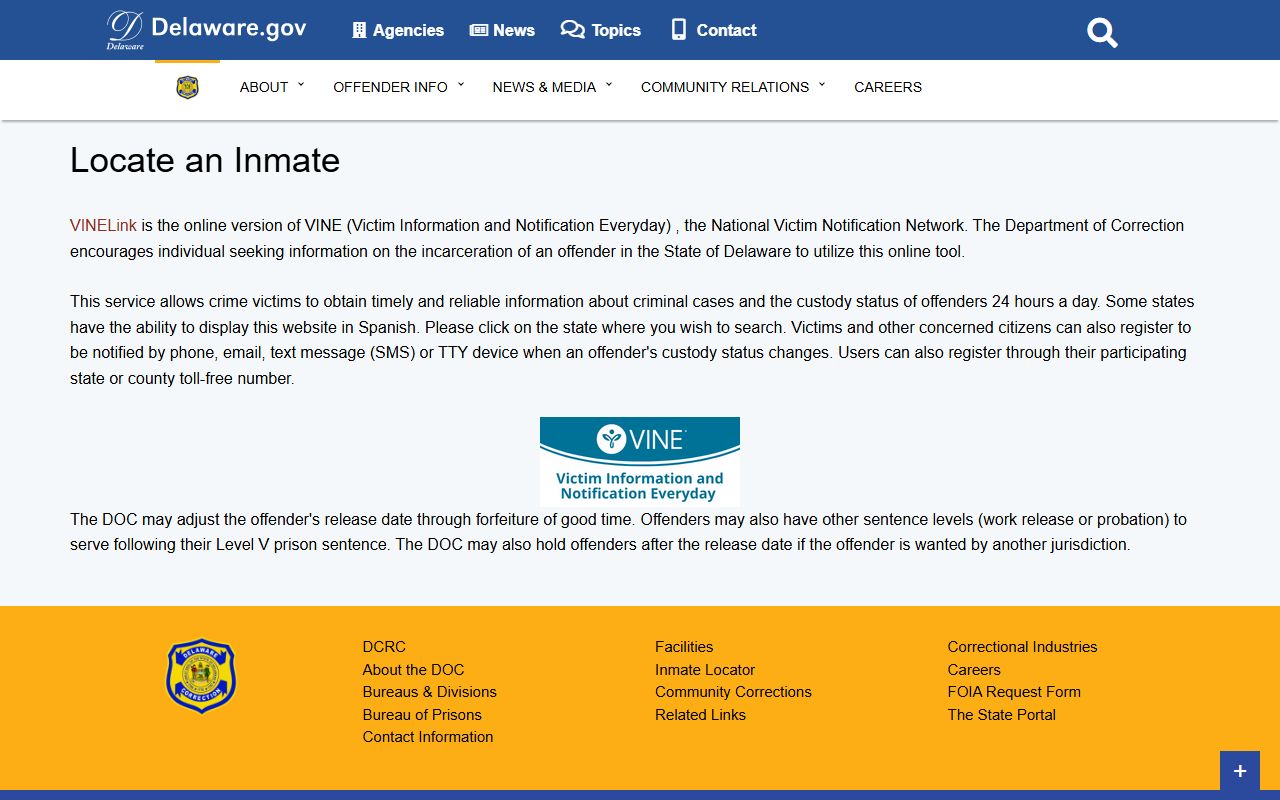
From there, users can pick Delaware on VINELink and sign up for phone, email, text, or TTY alerts. See the inmate records page for the full roster steps and warrant records for active warrant guidance. Also see the released inmates page and jail population data for DOC reporting.
Marriage, Divorce, and Probate Records
These three sit at different offices. Marriage licenses go through the New Castle County Clerk of the Peace at the county government center on French Street. Divorce is a Family Court matter at the Justice Center. Probate runs through the New Castle County Register of Wills. Contested estates can move to the Court of Chancery. The split is the single most important fact for anyone hunting vital records in the county. See the marriage and divorce records page and the probate records page for fuller walkthroughs.
The Clerk of the Peace page shows the marriage process and current rules. Open the Clerk of the Peace page to see the office's current instructions.
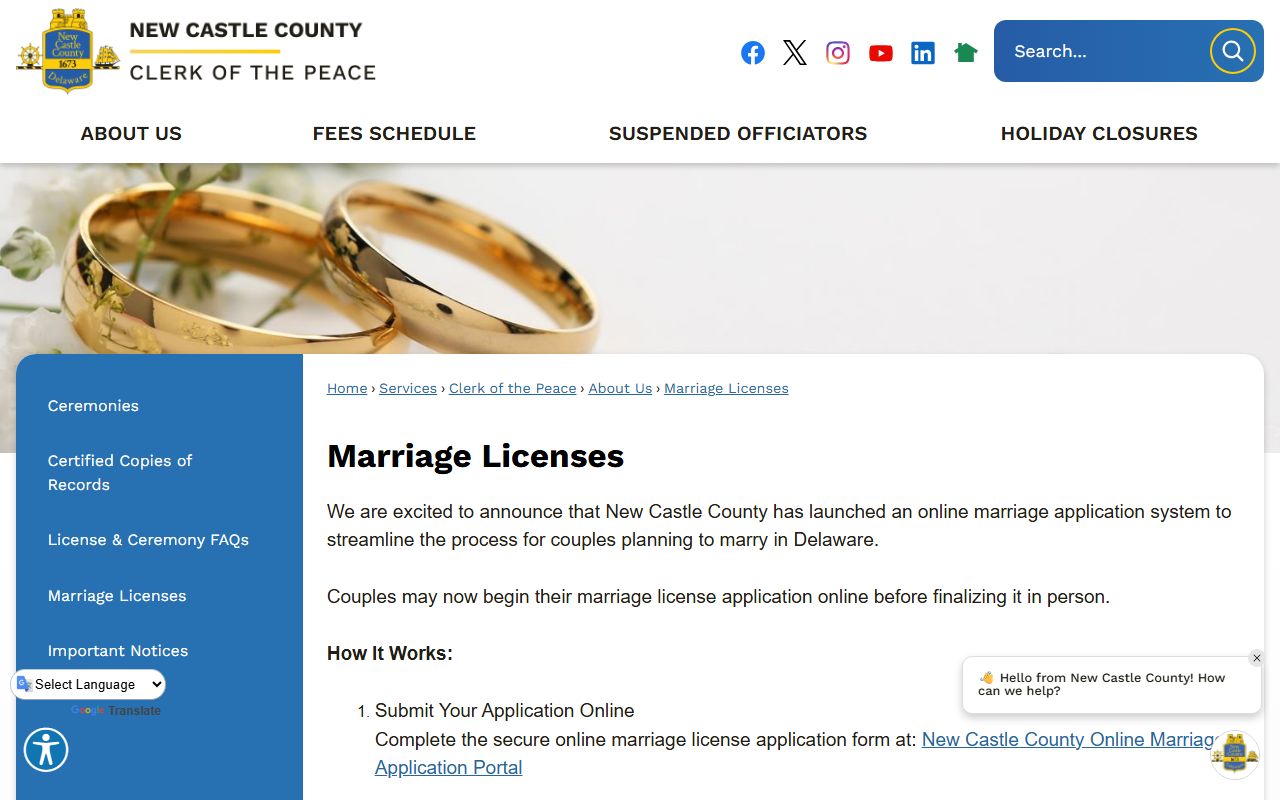
That page lists the office's marriage-license rules, fees, and appointment guidance.
The Register of Wills handles estate files, short certificates, wills, and probate forms. Open the Register of Wills page to see the probate office's current setup.
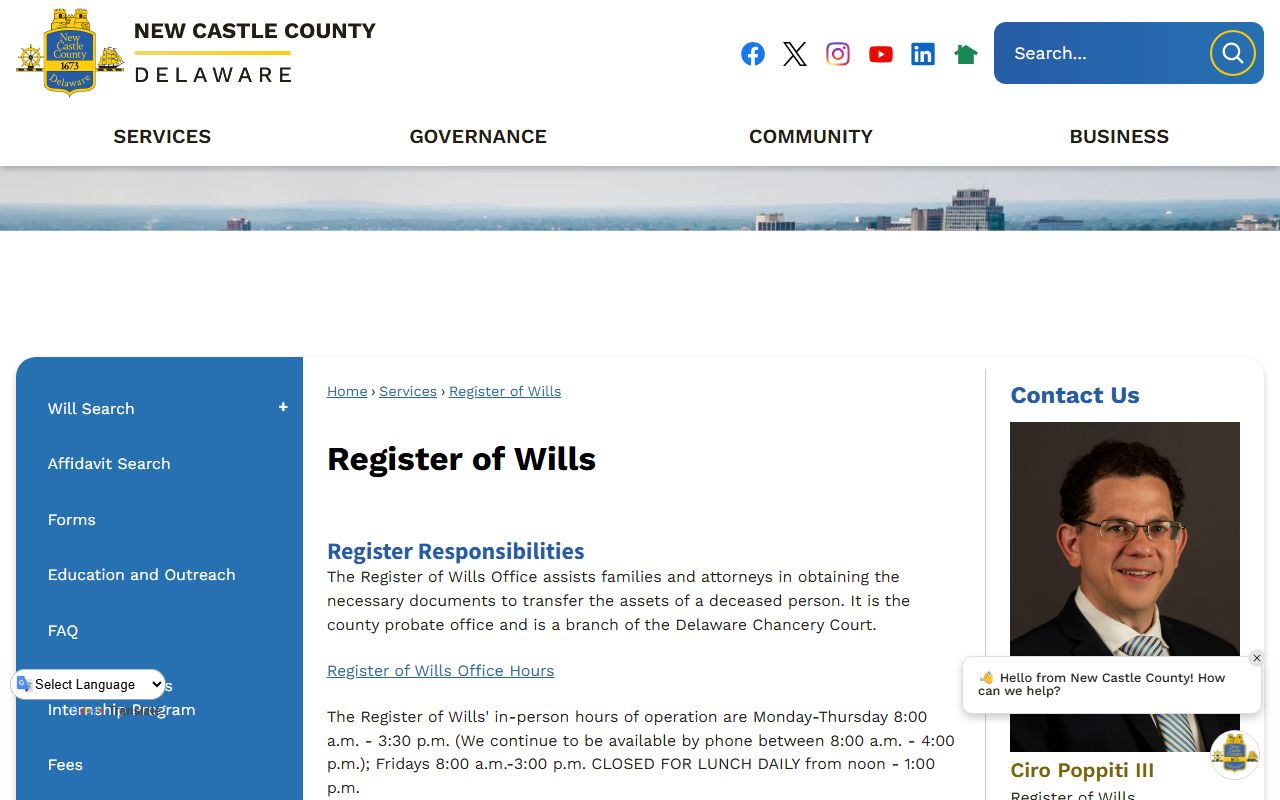
That page links to the county probate forms set, which covers opening, small-estate, inventory, and accounting filings.
- Testator
- A person who has made a valid will before death.
- Executor
- The person named in a will to administer the estate.
- Intestate
- Dying without a valid will; state law then sets who inherits.
- Guardianship
- Court appointment to care for a minor or an adult who cannot manage personal affairs.
- Conservator
- A person appointed by a court to manage another's finances or property.
- Short certificate
- An official document showing authority to act for an estate; banks and registries use it to transfer assets.
New Castle County Court Records Fees
Fees in Delaware are set per court division and per office, not by a single county fee schedule. The Prothonotary, Family Court, Court of Common Pleas, Justice of the Peace Court, Register of Wills, Clerk of the Peace, and Recorder of Deeds each publish their own fee data. Court filing fees follow the Delaware Courts fee schedule by court. Probate fees follow the Register of Wills fee page. Marriage license fees follow the Clerk of the Peace marriage page. FOIA charges for agency records follow 29 Del. C. § 10003B, which allows reasonable copy, administrative, and staff time costs. Always confirm the current number on the office's own page before paying.
The table below shows the kind of fee categories users face. Treat it as a checklist of items to verify rather than a fixed price list.
| Item | Source / Notes |
|---|---|
| Court filing fee | Set by each court division; verify on the Delaware Courts fee page for the relevant court |
| Certified copy | Office-specific; ask the Prothonotary, Family Court clerk, or Register of Wills |
| Probate fee | Register of Wills fee page; varies by estate size and task |
| Marriage license | Clerk of the Peace marriage-license page; county-set amount |
| FOIA copy charges | 29 Del. C. § 10003B; reasonable copy and staff-time cost |
| Recorded land document | Recorder of Deeds fee page |
How to Interpret New Castle County Court Records
A docket page reads dense at first. Codes and short labels stack up. Each line means something. A Case ID like N21C-08-063 marks the county (N for New Castle), the year (2021), the case-type code (C for civil), and the sequence number. Status codes pair with a written label. "CLOSED - CLOSED" means the case file is done. "OPEN - ACTIVE" means it is still in motion. Case-type codes also read as code plus text, such as "CG - DEFAMATION" or "61 - JP LANDLORD TENANT."
A charge is not a conviction. An arrest record shows what police said happened. A docket shows what was filed. A conviction shows what a court found or the defendant admitted. Dismissed with prejudice means the case is over and cannot be refiled. Dismissed without prejudice means it could come back if law allows. A capias is an order to bring someone to court. A writ is a formal command from the bench. Sealed and expunged are different. Sealed limits access. Expunged removes the record from ordinary public view.
Looking at a federal case from New Castle County uses different tools. The federal District of Delaware sits a few blocks from the state courthouse. Open the U.S. District Court for the District of Delaware page for federal case access.
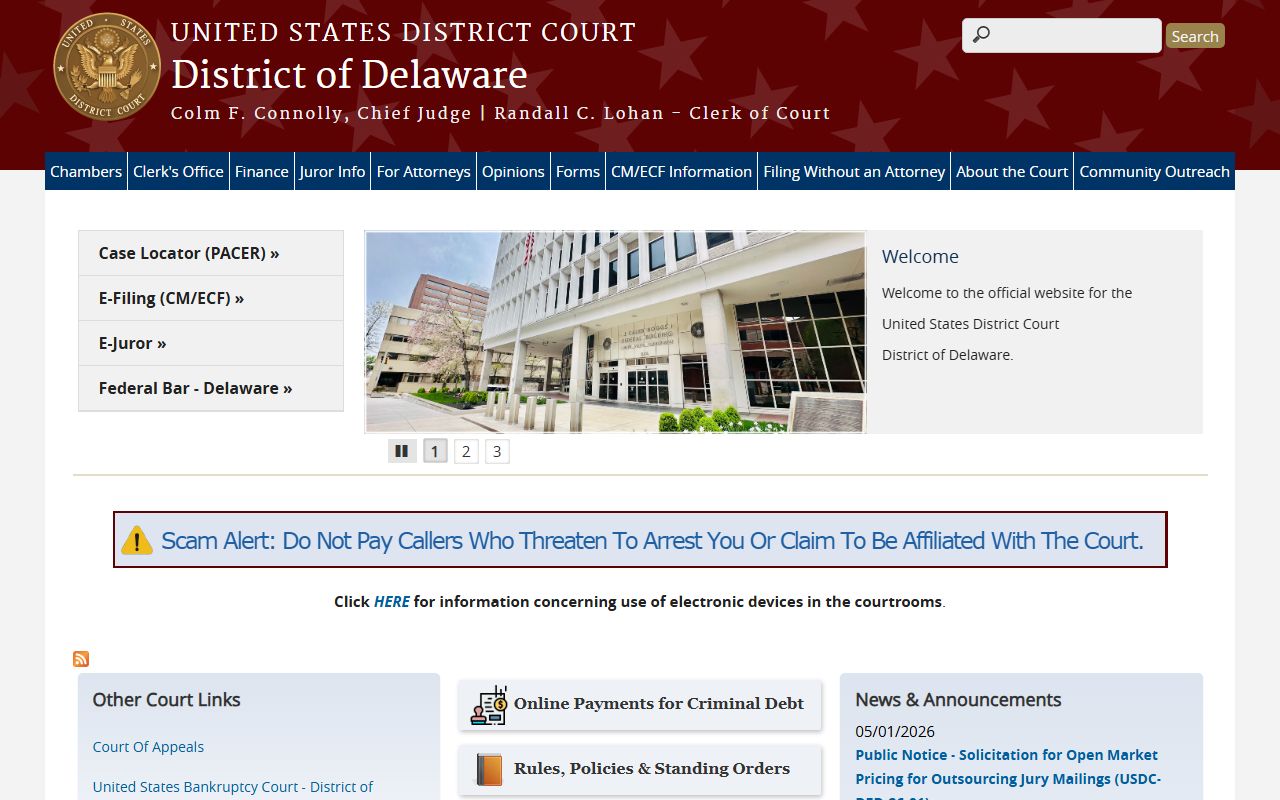
Federal dockets run through PACER. Free opinions and some RECAP docket pages live on CourtListener.
Accuracy and Record Limitations
Court records lag real life. CourtConnect's own disclaimer says timeliness is not guaranteed. Recent filings, sealed matters, and clerk processing delays may not show up right away. Names can be misspelled in the data. Status codes can be stale. DOC release dates may shift due to good-time, work release, or a detainer from another jurisdiction. The DOC inmate-locator page flags that a listed release date is not the same as the actual walk-out date. Anyone making a serious decision based on a court record should call the clerk, the court, or the agency that owns the file.
Errors get fixed at the source. If a docket entry looks wrong, call the clerk for that court. For criminal-history corrections, work through the Delaware State Bureau of Identification and the relevant court. For a sealed or expunged record showing up where it should not, the petitioner usually needs to follow up with the issuing court and any agency that received the disclosure.
Note: Confirm every detail with the originating clerk or office before relying on an online court record for legal, business, or personal decisions.
History of New Castle County Courts
New Castle County is one of Delaware's three original counties. Wilmington has long been the county's legal and business hub. The Court of Chancery is the most famous piece of Delaware's court system, with a national role in corporate law. Many large companies are incorporated in Delaware, and big corporate disputes land in Wilmington. The same downtown courthouse handles those nationally significant cases alongside everyday small claims, landlord-tenant work, and family matters.
The main building is named for Leonard L. Williams, a noted Delaware lawyer and jurist. Older case captions, news stories, and attorney files still use "New Castle County Courthouse" as the name. The state's move to online docket access, e-filing, and CourtConnect built on a long history of statewide court design. The Superior Court, Chancery, Family Court, Common Pleas, and JP Court each developed as state-level institutions instead of county courts with their own elected clerks. That is why a New Castle records search runs through state systems and a handful of county-level offices, not a single county clerk.
For self-help and pro bono help in this county, Delaware has a strong network. Resources include the Delaware Office of Defense Services, the Delaware Volunteer Legal Services, the Community Legal Aid Society, the Legal Services Corporation of Delaware, and the Delaware State Bar Association referral service. The Delaware Department of Justice prosecutes state crimes. Delaware does not use the title "county district attorney." That fact alone catches many out-of-state users by surprise.
Frequently Asked Questions
Where do I search New Castle County court records online?
Use Delaware CourtConnect for public civil docket and judgment searches. The search home supports name, business, case-type, judgment, and exact Case ID docket lookup. It is not a certified-copy system. For an official copy or a stamped filing, take the Case ID to the right court clerk. Family Court, JP Court, and probate records each have their own access rules and offices on top of the central docket portal.
What court handles felony cases in New Castle County?
The Superior Court handles felony criminal cases. Early steps may take place in JP Court or the Court of Common Pleas, depending on arrest and charge. Once a case is bound over or indicted, felony prosecution moves to Superior Court. Major civil suits also belong in Superior Court. The Court of Chancery sits to the side for equity, trust, guardianship, and corporate disputes.
Where do I get a marriage license?
Marriage licenses come from the New Castle County Clerk of the Peace, not from the courthouse Prothonotary. The office sits at the county government center on French Street in Wilmington. Use the Clerk of the Peace page for current ID rules, fees, and appointment guidance. Marriage license rules are statewide, but each Delaware county runs its own license process.
Does New Castle County have a sheriff jail roster?
No county sheriff roster is published. Delaware custody is administered by the Department of Correction. The DOC inmate-locator page sends users to VINELink for live custody and release notifications. The county's main DOC facility is Howard R. Young Correctional Institution in Wilmington. For federal custody, use the Bureau of Prisons inmate locator instead. See the inmate records page for full steps.
Are divorce records public?
Divorce is a Family Court matter. Some case data is searchable, but files with children, support information, or abuse allegations may be limited. Custody, PFA, and child-welfare filings are usually closed. Certified divorce decrees should be requested through Family Court. The marriage and divorce records page walks through the full request workflow.
More answers on the New Castle County court records FAQ page.